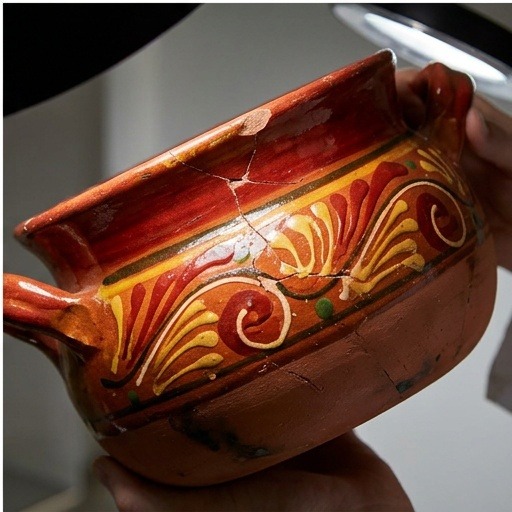
Most ceramic cookware sold by major Western brands is within California Prop 65 limits for leachable lead. That said: the FDA has issued an expanding warning since August 2025 about imported aluminum, brass, and aluminum-alloy cookware leaching significant lead — and traditional/decorative imported pottery has been documented to poison whole families. The line is not "ceramic = bad." The line is "imported decorative pottery and pre-2015 enameled cast iron sometimes test very, very badly."
The 2022 NYC family case report
CDC MMWR 2022 (Hore et al.) documented a family of five in New York with elevated blood lead levels traced to glazed ceramic cookware purchased in Mexico. The interior glaze contained 15.7 mg lead per cm². All five members had blood lead ≥ 5 µg/dL. Removing the cookware from the household reduced blood lead levels across the family.
FDA's 2024-2025 imported cookware warnings
Beginning December 12, 2024, the FDA issued a letter to retailers and distributors identifying imported cookware made of aluminum, brass, and aluminum alloys (sold as Hindalium/Hindolium and Indalium/Indolium) that leached lead. Manufacturer Rashko Baba Co. Ltd. was placed on Import Alert.
August 13, 2025 the FDA expanded the warning. Successive expansions in September, October, November, and December 2025 brought the list to 19+ products by year-end. The affected items are predominantly sold at South Asian and Latin American specialty grocers — a population the FDA has acknowledged is underserved by mainstream recall communications.
FDA leachable-lead action levels
FDA Compliance Policy Guide 545.450 sets action levels for leachable lead via 24-hour 4% acetic acid extraction:
- Flatware (plates): 3.0 µg/mL
- Small hollowware (mugs/bowls): 2.0 µg/mL
- Large hollowware: 1.0 µg/mL
- Cups and mugs: 0.5 µg/mL
- Pitchers: 0.5 µg/mL
These are enforcement triggers, not health-based safety thresholds. California Prop 65 sets a much stricter limit: 0.1 mg/L leach for cookware. Major brands (Le Creuset, Staub, Lodge enameled) self-test to the Prop 65 threshold.
XRF vs. leach testing — different questions
Tamara Rubin / Lead Safe Mama's XRF testing archive has documented lead in named ceramic-coated products at the parts-per-million level. XRF reads total lead in the substrate, not leachable lead — the metric that matters for federal action and dietary exposure. Both numbers matter for different reasons. XRF detection of low-ppm lead in a ceramic coating does not automatically equal food contamination at exposure-relevant levels — leach testing under acidic conditions is the determinative test.
Le Creuset and Staub — the honest read
Le Creuset's California AB1200 disclosure admits cadmium use in red, orange, and yellow EXTERIOR enamels — covered with anti-acid frit so the food-contact surface doesn't touch them. Independent XRF screens have detected lead, cadmium, and antimony in trace amounts within Prop 65 limits. Staub tests cleaner than Le Creuset across multiple Lead Safe Mama screens — the black matte enamel eliminates colored-pigment risk.
Plain-language summary
If you buy enameled cast iron from Le Creuset (neutral interior color), Staub, or current-production Lodge enameled — your risk is low. If you have inherited ceramic dishware, decorative pottery from foreign markets, or pre-2015 dark-color enameled Dutch ovens — get them tested or stop using them for food contact.
The vintage problem
Pre-1986 Fiestaware orange/red contains uranium glaze (radioactive). Pre-1990 painted Pyrex exteriors leach lead from the paint when scratched. Vintage CorningWare and imported ceramic mugs are the real high-risk category. The community on r/Pyrex and r/vintage has worked through this extensively.
Cross-border ecommerce concern
The FDA's expanding 2024–2025 recall list overlaps heavily with cookware shipped directly from Chinese, Indian, and Pakistani warehouses through Temu, AliExpress, and TikTok Shop. CBP historically inspected only 0.06% of these shipments under the de minimis loophole. Read the full investigation →
Tested-safe alternatives
Cookware that has been independently XRF-tested lead-free, or that has no glaze chemistry to leach in the first place.
- Lodge plain cast iron — Tamara Rubin XRF: lead non-detect since 2015
- All-Clad D3 stainless — no enamel, no glaze, no lead pathway
- Staub 5.5qt black matte — neutral enamel, cleaner XRF than colored Le Creuset
Affiliate links — we may earn a commission at no cost to you. See our disclosure.